Introduction
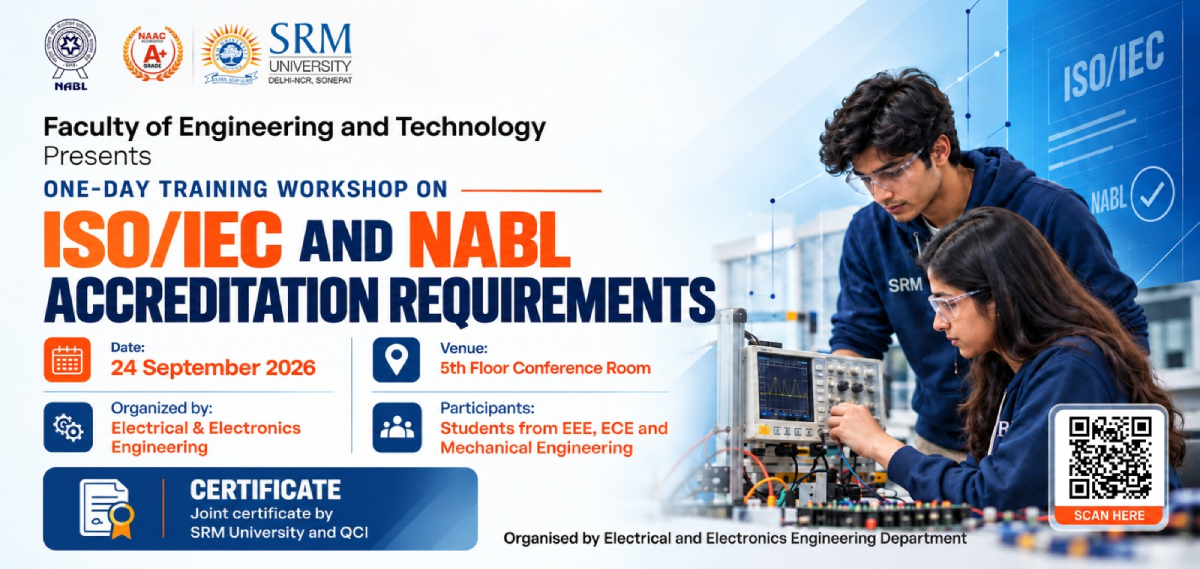
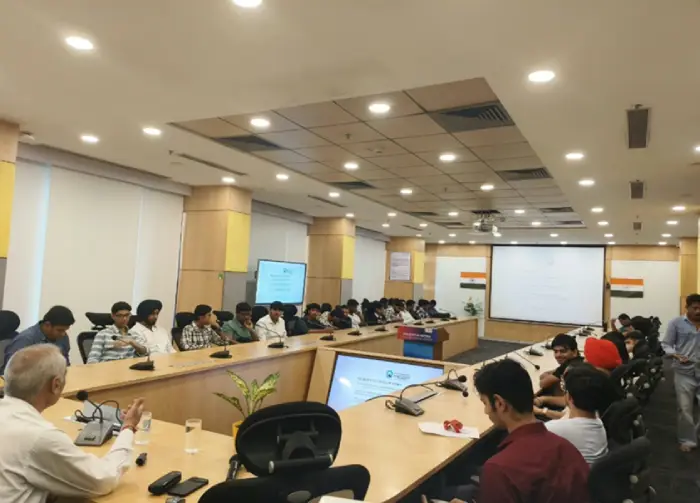
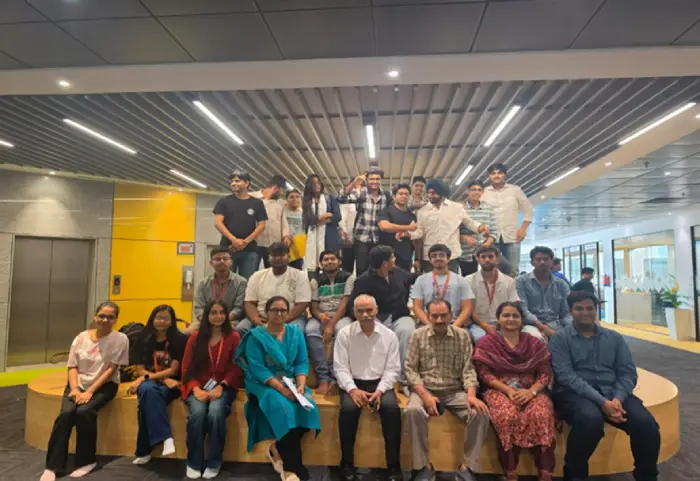
The Department of Electrical & Electronics Engineering, Faculty of Engineering and Technology, SRM University Delhi-NCR, Sonepat, organised a One-Day Training Workshop on “ISO/IEC 17025:2017 & NABL Accreditation Requirements” on 24 September 2026 at the 5th Floor Conference Room. The workshop aimed to familiarise participants with the requirements of ISO/IEC 17025:2017 and the National Accreditation Board for Testing and Calibration Laboratories (NABL) accreditation framework, with particular emphasis on laboratory competence, quality assurance and compliance with established testing and calibration standards.
Objectives of the Programme
- To familiarise participants with the scope, structure and key requirements of ISO/IEC 17025:2017 for testing and calibration laboratories.
- To create awareness about the NABL accreditation framework, its significance, benefits and accreditation procedures.
- To develop an understanding of laboratory competence requirements, including personnel, infrastructure, environmental conditions and equipment.
- To explain the importance of metrological traceability, measurement accuracy and reliability of test and calibration results.
- To provide insights into laboratory processes, quality assurance, risk management and management-system requirements under ISO/IEC 17025:2017.
- To familiarise participants with NABL guidelines, accreditation documents and online resources.
- To bridge the gap between theoretical knowledge and practical laboratory requirements, preparing students for quality-conscious professional practices in testing, calibration and conformity assessment.
The TOEFL Mock Test was held on 21 September 2026 from 10:00 AM to 1:00 PM for the final year students and 1:30 to 4:30 for pre-final year students in the 5th Floor Conference Hall, Engineering Block, SRMUH. It was aimed at final & pre-final year students aspiring to study abroad and consisted of a 2-hour supervised mock test followed by a 1-hour briefing and debrief, conducted by Mr Lakshmi Narayan and Mr Irfan Khan of Education Matters. A total of 47 students participated. The Global Education Fair followed on 22 September 2026, also from 10:00 AM to 3:00 PM, at the Foyer Square, Ground Floor, New Academic Block, SRMUH.
Program highlights
The programme commenced with a welcome address and introduction by Dr. Deepika Yadav, Head, Department of Electrical & Electronics Engineering. She highlighted the relevance of ISO/IEC 17025:2017 and NABL accreditation in ensuring the reliability, accuracy and credibility of testing and calibration laboratories.
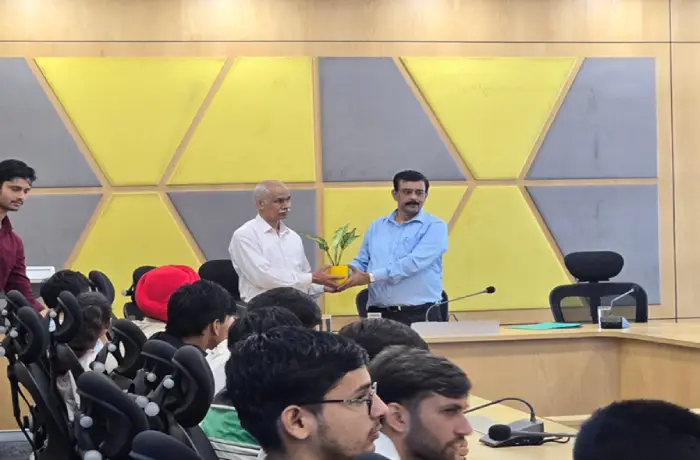
Prof. Ranjit Roy, Dean, Faculty of Engineering and Technology, addressed the participants and emphasised the importance of industry-oriented training and exposure to nationally recognised quality and accreditation frameworks. The expert was felicitated with a sapling as a token of respect and gratitude.
The workshop comprised a series of structured technical sessions covering the key clauses of ISO/IEC 17025:2017, along with an introduction to NABL, the benefits of accreditation and the relevant resources available on the NABL website.
The sessions covered the scope, normative references, terms and definitions, general requirements, resource requirements, process requirements and management-system requirements of the standard. Particular emphasis was placed on personnel competence, laboratory facilities, environmental conditions, equipment, metrological traceability, externally provided products and services, and the processes necessary to ensure the validity of laboratory results.
The detailed programme schedule was as follows:
| Time |
Session |
| 09:55–10:00 |
Welcome and introduction to the programme |
| 10:00–10:10 |
About NABL and benefits of NABL accreditation |
| 10:10–10:30 |
ISO/IEC 17025:2017 — Scope, normative references, terms and definitions
(Clauses 1–3)
|
| 10:30–10:45 |
Tea break |
| 10:45–11:00 |
General requirements (Clauses 4–5) |
| 11:00–11:20 |
Resource requirements — General requirements, personnel, facilities and
environmental conditions (Clauses 6.1–6.3)
|
| 11:20–11:50 |
Resource requirements — Equipment, metrological traceability, externally
provided products and services (Clauses 6.4–6.6)
|
| 11:50–12:30 |
Process requirements (Clauses 7.1–7.6) |
| 12:30–13:30 |
Lunch break |
| 13:30–14:00 |
Process requirements (Clauses 7.7–7.11) |
| 14:00–15:00 |
Management-system requirements (Clauses 8.1–8.9) |
| 15:15–15:55 |
NABL website and documents |
| 15:55 onwards |
Closing session |
The sessions enabled participants to develop a systematic understanding of the standard and its application in laboratory operations. The discussion on NABL documentation and accreditation procedures further familiarised participants with the resources and requirements relevant to laboratories seeking accreditation.
Participation and Learning Outcomes
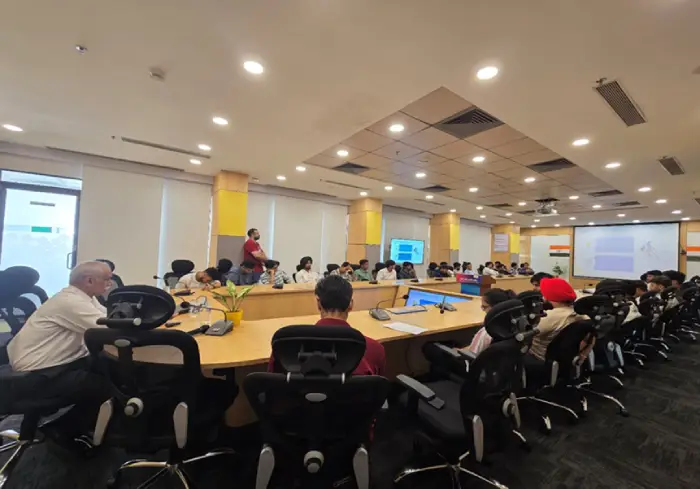
Students from the Departments of Electrical & Electronics Engineering, Electronics & Communication Engineering, and Mechanical Engineering participated in the workshop.
The programme provided participants with structured exposure to the principles of laboratory competence and accreditation. The key learning outcomes included:
- Understanding the structure, scope and major requirements of ISO/IEC 17025:2017.
- Familiarisation with personnel competence, laboratory facilities, environmental conditions and equipment requirements.
- Understanding the significance of metrological traceability and the reliability of measurement results.
- Gaining insights into laboratory processes, quality assurance and management-system requirements.
- Developing awareness of NABL accreditation, its benefits, and the relevant guidelines and documentation available through the NABL website.
The workshop also helped bridge the gap between theoretical knowledge and the practical requirements of testing and calibration laboratories, thereby enhancing participants’ awareness of quality standards and professional laboratory practices.
Acknowledgement
The organising team expressed its sincere gratitude to NABL and the Quality Council of India (QCI) for their support and association in conducting the workshop. The team also acknowledged the guidance and encouragement extended by the university leadership, faculty members and student coordinators.
Special appreciation was extended to Dr. Deepti for facilitating coordination between the NABL and SRM teams. The contributions of the student coordinators, Mr. Arpit and Mr. Sourav, were also acknowledged for their assistance in the organisation and smooth conduct of the programme.
Conclusion
The One-Day Training Workshop on “ISO/IEC 17025:2017 & NABL Accreditation Requirements” provided a valuable platform for students to understand the essential principles of laboratory competence, quality management and accreditation. The expert-led sessions offered practical insights into the implementation of ISO/IEC 17025:2017 and the role of NABL in promoting reliable testing and calibration practices.
The programme reinforced the importance of standardisation, measurement accuracy, technical competence and continuous improvement in laboratory operations. It concluded with a vote of thanks to the resource person, university leadership, participating students and organising team for their valuable contributions to the successful conduct of the workshop.